
Water-Absorbent Expansion Bag Manufacturer: The Key to Superior Absorbency Solutions
2026-10-30
What if a simple bag could turn the tide during a flood emergency? Water-absorbent expansion bags have become a frontline defense, but not all manufacturers deliver the same performance. At Jianghe Flood Prevention, we've spent years perfecting absorbency technology that swells fast, holds strong, and deploys without fuss. The difference lies in details most suppliers overlook—and that's exactly what we're unpacking here. Whether you're managing municipal infrastructure or safeguarding a construction site, understanding the core of superior absorbency could save you more than just time.
Inside the Polymer Science That Sets Quality Expansion Bags Apart
The performance of a premium expansion bag hinges on polymer architecture more than most converters realize. Narrow molecular weight distributions in metallocene-catalyzed polyethylene enable consistent film gauge and predictable bubble stability during blown film extrusion. A trace amount of long-chain branching, introduced through careful reactor design, raises melt strength without sacrificing drawdown, so the parison inflates uniformly instead of developing thin spots that lead to premature rupture.
Copolymer selection is another lever that separates ordinary bags from those that survive repeated pressurization cycles. Incorporating 1-hexene or 1-octene as a comonomer creates short-chain branches along the backbone, disrupting crystallinity just enough to boost resistance to slow crack growth. This molecular adjustment also lowers the brittle-to-ductile transition temperature, meaning the bag retains toughness when cold air or chilled contents cause sudden thermal contraction.
How these polymers are processed ultimately determines whether the molecular advantages translate into real-world durability. During blown film extrusion, strain-induced crystallization and molecular orientation align chains in both the machine and transverse directions, creating a balanced network that distributes stress evenly across the seam. Controlling the cooling rate and blow-up ratio allows manufacturers to tune the relaxation time of the melt, producing a wall with uniform thickness and a seal that holds under internal pressure spikes without delaminating.
How Custom Bag Dimensions and Fill Rates Match Real-World Flood Control
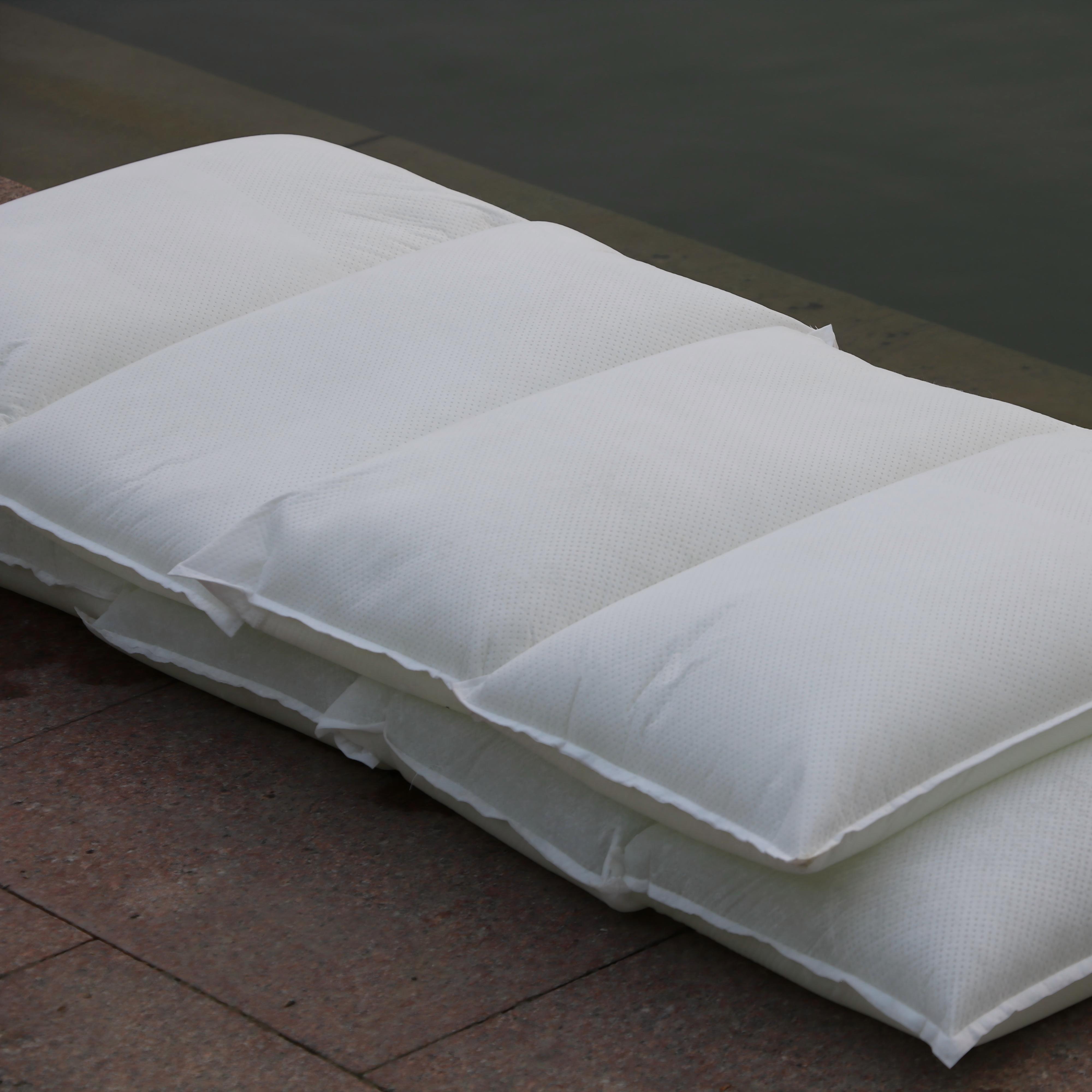
Flood control rarely happens on a perfectly flat, open field. Doorways, culvert openings, utility boxes, and uneven ground all demand bag shapes that can conform without leaving channels for water to slip through. Custom bag dimensions solve this by letting crews order longer, narrower bags for wrapping around pipes or shorter, wider bags for building low, stable walls in tight spaces. The point isn't just having more sizes on hand—it's matching the bag's footprint to the actual gap or slope so that each layer locks into the next instead of sliding or bulging.
Fill rate gets treated as a one-size-fits-all number, but real-world results change with bag size and fill material. A bag packed to 90% capacity feels satisfyingly heavy, yet it becomes rigid and leaves fingertip-sized gaps at the seams. Underfill it below 60%, and the bag flattens under load, reducing wall height faster than expected. With custom dimensions, the ideal fill rate shifts: a long, narrow bag may need slightly more material to hold its shape, while a squat, wide bag can perform well at 65–70% because its low center of gravity resists rolling. Testing a few rates on-site with the actual sand or gravel mix is cheaper than discovering a weak spot when the water arrives.
Why Reliable Manufacturers Test Beyond Standard Absorption Claims
Standard absorption ratings from a lab datasheet rarely survive first contact with a real spill. They assume a flat, non-porous surface, a controlled liquid viscosity, and a technician with time to spare. Reliable manufacturers know that factories, loading docks, and repair bays never match those conditions. So they test on sloped concrete, under forklift traffic, with oil that has already mixed with dust and coolant. That is where a claimed 20-gallon absorbency either proves itself or collapses into a slick, useless mat.
Testing beyond the standard also means pushing the product past its advertised limit, not just to it. A manufacturer worth trusting will saturate a pad, wring it, then saturate it again. They will measure what happens when the mat is torn, folded, or left in direct sunlight for a month. Cheap absorbents pass one clean lab test. The good ones survive repeated abuse and still hold together. The difference shows up in fewer change-outs, less downtime, and a floor that is safe to walk on rather than merely dry-looking.
Perhaps most telling is how manufacturers treat the liquids no one puts on a spec sheet: hot hydraulic fluid, diesel mixed with degreaser, even a puddle of transmission fluid with metal shavings in it. Standard tests avoid these because they are messy and unpredictable. Reliable manufacturers lean into them, because they know that is what you actually mop up. If a supplier cannot describe how their product behaves under those conditions, you have to wonder if they have ever left the lab.
From Mines to Construction: Unpacking Niche Applications That Demand More
Heavy-duty machinery rarely gets a second glance until it fails in a place where replacement means shutting down an entire operation. In underground mines, for instance, hydraulic systems must cope with abrasive dust, constant vibration, and temperatures that swing without warning. Standard seals and bearings simply give up too soon, which is why specialized materials like tungsten carbide coatings and high-nitrile elastomers have become non-negotiable. The demand here isn't for incremental improvement—it's for components that can survive 20,000 hours of punishment while still allowing miners to extract ore without unscheduled stops.
Shift the scene to a high-rise construction site, and the challenges mutate. Tower cranes need slewing rings that handle massive overturning moments, yet still rotate smoothly after years of exposure to rain, concrete splatter, and wind-induced oscillations. Off-the-shelf industrial bearings often fail at the raceway edges because the load distribution is never uniform. Contractors have learned to specify case-hardened, induction-quenched rings with custom groove geometries—details that never appear in a product catalog but make the difference between a crane that erects 40 floors without a hitch and one that grinds to a halt mid-pour.
What ties these niche applications together is a quiet rejection of 'good enough.' Mining and construction are not showcases for generic engineering; they are unforgiving proving grounds. The buyers who thrive in these sectors don't ask for a part number—they bring photos of wear patterns, torque logs, and failure analyses. They want a supplier who understands that a conveyor roller in a potash mine and a mast guide shoe on a concrete pump share a hidden DNA: both must resist fretting corrosion under oscillating loads, both must shrug off contamination, and both must keep doing it when maintenance windows shrink from days to hours. That's the real meaning of 'demand more'—not a slogan, but a design constraint written in downtime costs and safety margins.
The Sustainability Edge: Reusable Materials and Responsible Disposal
Walk into a busy café on a weekday morning and you will likely see a stack of single-use cups vanishing within the hour. Now picture that same café swapping those cups for sturdy glass jars or stainless steel tumblers that customers return after their drink. Reusable materials shift the focus from constant replacement to long-term use, cutting down the raw resources pulled from the earth and the energy burned in manufacturing each disposable item. A well-designed reusable container might last hundreds of trips, and its slight extra weight or initial cost fades against the mountain of waste it prevents. The real edge comes from treating durability as the default, not a premium add-on, and from making return or refill systems feel effortless rather than like an extra chore.
Responsible disposal closes the loop that reusables start. Even the best materials wear out eventually, and what happens then matters as much as how long they served. Composting food-soiled fiber packaging, separating metals and glass for high-quality recycling, or sending worn-out textiles to fiber recovery programs keeps materials in circulation instead of burying them in landfills. Some companies now take back their own products at end of life, strip them down, and feed the components into new items, avoiding the downcycling that turns a once-valuable resource into low-grade filler. The advantage is not just environmental; it is operational too, because predictable return streams reduce the cost of sourcing virgin materials. When reusable design pairs with a clear, honest disposal path, the entire system becomes resilient rather than dependent on the next cheap disposable fix.
Building Long-Term Supplier Relationships That Keep Projects Moving
Instead of treating suppliers as interchangeable vendors, successful project managers invest time in understanding a supplier's constraints, production cycles, and communication preferences. This means sharing forecast data early, flagging potential delays before they become emergencies, and asking what the supplier needs from you to hit deadlines. When both sides stop hiding problems, the relationship becomes a buffer against the inevitable disruptions that stall construction or manufacturing schedules.
Long-term partnerships also change how you negotiate. Rather than squeezing every last cent from each order, you start looking at total cost across a year: fewer rush fees, fewer quality failures, fewer hours lost to chasing missing parts. Suppliers who know they'll get repeat business are more likely to hold capacity for you during peak seasons or reroute a truck when a site hits an unexpected bottleneck. That kind of flexibility cannot be bought with a one-off contract.
The most practical step is to set a simple rhythm: a monthly call that reviews upcoming demand, a shared spreadsheet for open issues, and a rule that no surprise gets older than 48 hours. Over time, this cadence turns a transactional relationship into an operating extension of your own team. Projects move faster because the people supplying materials or services are already aligned with your schedule before the first delay forces a conversation.
FAQ
These bags contain a superabsorbent polymer that swells rapidly when exposed to water, turning into a gel-like barrier. They are often used to block leaks, control flooding, or protect structures from water intrusion by expanding to many times their dry size.
A reliable manufacturer combines consistent polymer quality, precise bag sealing, and thorough batch testing. They also understand different deployment scenarios—like construction joints, utility vaults, or temporary dikes—so their products hold up under real-world pressure rather than just in a lab.
They show up in civil engineering, underground utilities, flood defense, mining, and even telecommunications. Anywhere water can seep through cable ducts, pipe penetrations, or concrete seams, these bags provide a fast, low-profile seal.
Yes. Beyond standard sizes, manufacturers often adjust absorbency speed, gel strength, outer fabric, and even shape to fit unusual openings. Some projects need rapid expansion in cold water, while others prioritize long-term stability in saline conditions.
Request samples and test them under conditions that mirror the actual job—temperature, water chemistry, and pressure. Check whether the bag expands evenly without rupturing, how long the seal lasts, and whether the outer material resists tearing during installation.
The polymer inside is generally inert once hydrated, but responsible manufacturers provide disposal guidance and avoid toxic additives. Users should confirm that the materials meet local environmental rules, especially when bags may be left in place permanently or come into contact with drinking water.
They often focus only on the lowest price and ignore expansion ratio, gel consistency, or seam strength. Another mistake is not asking about minimum order quantities and lead times, which can delay projects if the supplier cannot scale up quickly.
Conclusion
A water-absorbent expansion bag manufacturer does more than stitch fabric around a polymer. The real difference shows up in how the polymer is selected and processed—quality bags use cross-linked polyacrylate blends that swell predictably instead of turning to gel mush under pressure. Custom dimensions and fill rates matter just as much: a bag built for a doorway flood barrier won't perform the same as one shaped for a mine shaft or a construction trench, and adjusting the fill percentage keeps weight manageable while still hitting the needed expansion volume. Reliable manufacturers also push beyond the standard lab soak test. They simulate uneven water contact, repeat wet-dry cycles, and check for seam stress after full expansion, because real floods never behave like a clean beaker of water.
The same attention shows up in specialized sectors. Mines and construction sites demand bags that hold up against silt, chemicals, and rough handling—not just clean tap water. That's why the best suppliers offer field-tested variants with reinforced outer shells or slower-release polymers for controlled seepage. Sustainability has moved from a buzzword to a design constraint: reusable materials, washable outer layers, and clear disposal guidance after contact with contaminated water keep projects compliant without adding landfill guilt. And when a supplier treats each order as part of a longer relationship—keeping batch quality consistent, holding buffer stock for emergencies, adjusting specs as site conditions change—the result is a flood response or excavation operation that doesn't stall when the next storm hits.
Contact Us
Contact Person: Kristin Zhang
Email: [email protected]
Tel/WhatsApp: +8615366239752
Website: https://www.jianghecn.com/