

Private Label Abrasive Paper: A Complete Sourcing Guide for Your Brand
2026-09-10
The moment you decide to launch a private label abrasive paper line, a flood of questions hits: Which grit range do your customers actually need? How do you avoid inconsistent backing materials that ruin a finish? And where do you find a manufacturer who treats your brand as more than just another SKU? This guide cuts through the noise. We’ll walk you through essential specs, quality checks, and negotiation points — all drawn from real sourcing conversations. Along the way, you’ll see why SHENZHEN SUN ABRASIVES has become a go-to partner for brands that refuse to compromise on performance or delivery. No fluff, no recycled tips — just the exact path to a private label line you’re proud to put your name on.
What Actually Goes Into a Sheet of Private Label Abrasive Paper
The core of any sheet starts with the backing. For private label runs, the paper is usually a heavy-weight latex-saturated stock that resists tearing and curling. Some orders specify a flexible A-weight or firmer C-weight, depending on whether the end use is hand sanding contours or machine finishing flat surfaces. The difference shows up quickly in the shop: thinner backings fold and crease more easily, while stiffer sheets hold a crisp edge longer.
On top of that sits the abrasive grain and the bond that holds it. Most private label lines default to aluminum oxide for general woodworking or metal prep, but switching to silicon carbide changes the feel on hard finishes, while ceramic or zirconia grains are saved for heavier stock removal. The resin bond is just as important as the grain type—two coats of phenolic resin give a more aggressive cut and longer life than a single hide-glue layer, and that choice often separates budget sheets from professional-grade ones.
Coating style matters too. Closed-coat sheets pack abrasive grains tightly for maximum contact on painted or primed surfaces, but they load up fast on soft woods or aluminum. Open-coat versions leave deliberate gaps, giving swarf a place to go. Many private label buyers also request a stearate layer—basically a dry lubricant that keeps heat down and stops the paper from glazing over. It's a small addition that noticeably changes how long a sheet lasts between changes.
Reading Between the Grit Numbers: Matching Abrasives to Your Customers' Jobs
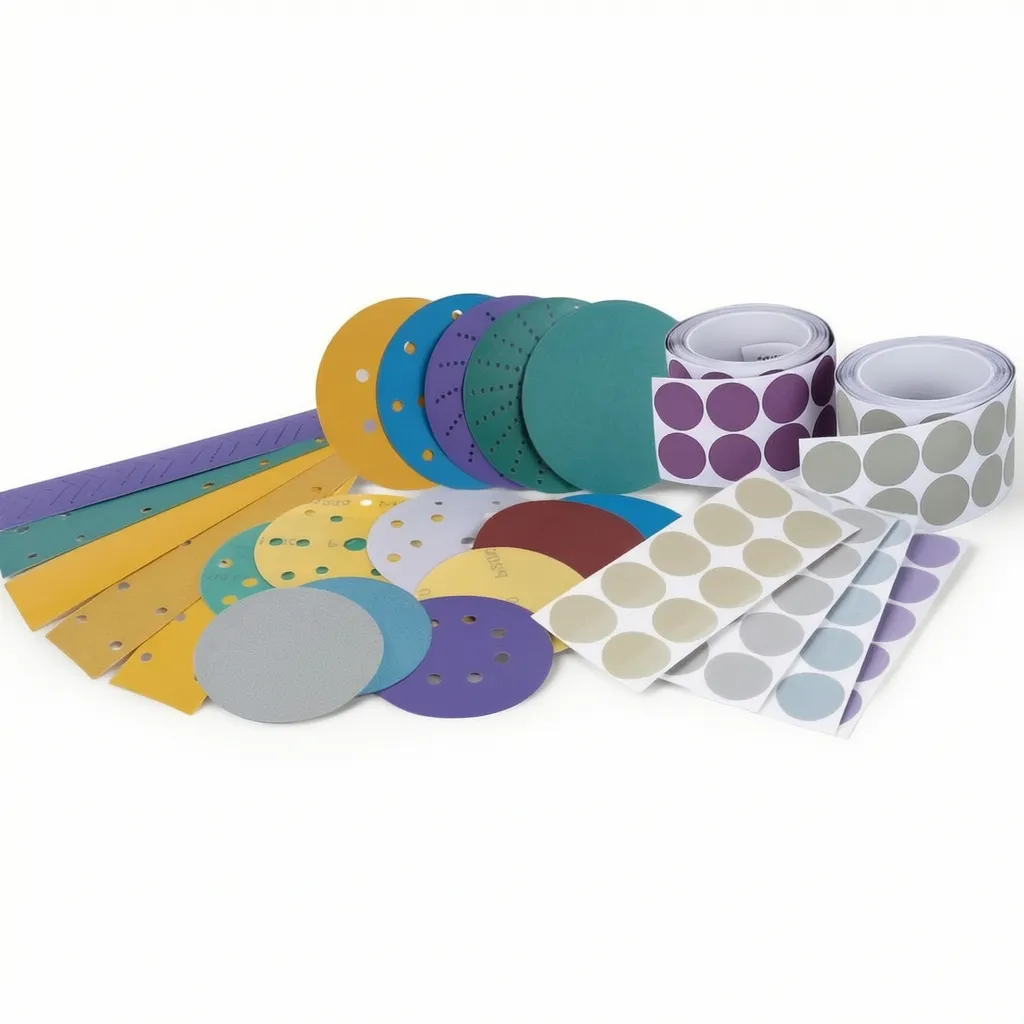
A 60-grit belt from one supplier can cut and finish completely differently than a 60-grit belt from another. The number only tells you the average particle size, not the grain type, how tightly it's packed, or how it sheds. Aluminum oxide tends to dull evenly and is forgiving on wood; zirconia and ceramic fracture more aggressively and are better for heavy stock removal or stainless. If you reach for the same grit every time, you'll leave performance on the table.
Match the abrasive to the job by asking two questions: what material are they working, and what does "done" look like? For soft woods and painted surfaces, a closed-coat aluminum oxide with a lighter backing can blend without digging in. For welds, mill scale, or harder alloys, an open-coat ceramic with a stiffer backing clears swarf and keeps cutting. Also consider the interface: a hard platen gives flat, aggressive contact; a soft pad lets the grit float for contoured finishing.
Don't overlook the role of friability and coating. Friable grains fracture to expose fresh edges, which keeps the scratch pattern consistent but may wear faster. Semi-friable or durable grains hold their shape longer, ideal for consistent dimensioning. A closed coat packs grains tightly for finer finishes and harder materials, while an open coat leaves room for dust to escape, preventing loading on gummy or soft stock. Reading those details behind the grit number turns a guess into a deliberate choice.
The Factory Visit Questions Most Brands Forget to Ask
During a factory visit, most brands focus on capacity, lead times, and defect rates. But the sharper questions are often the ones that reveal how a factory handles the unexpected. Ask to see the rework area, not just the final inspection line. Watch how workers respond when a supervisor walks past — do they look up, hide something, or keep their rhythm? The answers tell you more about real quality culture than any ISO certificate on the wall.
Another overlooked area is material storage. Walk to the back corner where raw materials sit. Are fabrics or components stacked directly on the floor? Is there a first-in, first-out system, or do older lots get buried under newer ones? If a brand never asks, the factory may never fix it. The resulting contamination, moisture damage, or mixed batches only show up later in your own returns data.
Finally, ask about the line’s changeover process. When a factory switches from your product to another client’s style, how do they clear leftover components? A vague answer — “we have a checklist” — is not enough. Ask them to show you a recent changeover record. If it’s blank or signed off in a hurry, that’s a warning sign. These are the questions most brands skip, and they’re exactly the ones that prevent midnight emails about mixed labels and wrong buttons.
Backing, Bond, and Grain: Where Quality Hides in Plain Sight
Walk into any showroom and your eye lands on the face of the carpet—the color, the pattern, the soft promise underfoot. But the real story is told on the flip side. The backing, the bond, and the grain rarely get a second glance, yet they decide whether that beautiful surface will sag within a year or stay crisp for a decade. Cheap backings crumble into dust; a weak bond lets the top layer ripple and peel. These are not flaws you notice on day one—they creep in after months of vacuuming, sunlight, and foot traffic.
A quality backing feels dense and springy, not papery. Press your thumb into it—if it gives too easily and stays indented, the material is already tired. The bond matters just as much: pull at a corner where the face meets the backing. A tight, even adhesion means the layers were fused under proper heat and pressure, not glued with the equivalent of school paste. Look at the grain, too. In woven or tufted carpets, the direction of the pile should be consistent, with no stray fibers standing up like cowlicks. Run your hand across the surface in both directions—one way smooth, the other slightly resistant. That resistance is the grain telling you the fibers are still aligned, not matted or crushed.
None of this requires a magnifying glass or a lab. Bend a corner of the carpet back and watch how the backing behaves—it should flex without cracking. Sniff it; a sour, chemical smell often signals unstable adhesives. Then set it flat and look across the surface at a low angle. The light will reveal uneven grain or shadowy patches where the bond has already begun to fail. These small rituals take thirty seconds, but they separate a floor covering that merely looks good today from one that still looks good after five years of real life.
Negotiating Minimums Without Getting Locked Into Inventory You Can't Move
The first rule is to never accept the listed minimum as fixed. Many suppliers set that number to cover their own production run costs, not because it reflects what a new buyer can realistically sell. Ask for a trial order, even if it comes at a slightly higher per-unit price, and tie future discounts to hitting agreed volumes over time.
Another approach is to negotiate staggered delivery schedules. Instead of taking 1,000 units all at once, commit to 1,000 over three or four shipments with dates spread out. This keeps the factory's line running while giving you room to test demand and adjust colors, sizes, or packaging before the next batch locks in.
You can also push for a mix-and-match clause. If the factory wants you to take 500 units, make it 250 of one style and 250 of another, or combine multiple SKUs to reach the minimum. This way you're not stuck with a wall of identical products that all move at the same pace—some will sell faster, and you can reorder those without being forced to take more of the slow ones.
From Bulk Rolls to Retail-Ready Boxes: Packaging Decisions That Shape Your Margins
Many operators assume the move from bulk rolls to retail-ready boxes is just a change in packaging format, but the financial ripple effects run far deeper. Bulk rolls often hide labor costs in the repacking process, along with higher damage rates from repeated handling. Shifting to retail-ready boxes can cut those hidden expenses, yet only if the box dimensions, material thickness, and case count are matched to actual shelf turnover. A box that looks impressive on the shelf but forces retailers to overstock slower-moving items will quietly erode margin through returns and markdowns.
Worth close attention are the less obvious choices, such as pre-formed boxes versus flat blanks assembled on-site, the weight of the corrugated board itself, and whether the package can be opened and restocked without tools. Each of these changes either adds seconds to a store associate's routine or removes them. Over a distribution network, those seconds translate into either higher handling fees or smoother restocking cycles. Retail-ready packaging also tends to carry higher upfront unit costs, so the real margin question is whether the reduction in labor and damage outweighs the premium per box. When the math is done honestly, many companies discover that a small increase in packaging spend buys a disproportionate drop in total landed cost.
FAQ
Ask for real production line photos and a recent third-party test report before you commit. A dependable factory will share batch records without hesitation and explain how they control coating uniformity. Watch out for suppliers who only offer glossy catalog shots and vague promises about quality.
Aluminum oxide works for most wood and general metal work, but if you want a sharper cut on hard finishes or composites, silicon carbide is worth the extra cost. Ceramic grain holds up longer under high heat and heavy pressure, so it suits professional auto body or metal fabrication lines. Don't just pick the cheapest option; match the grain to the specific jobs your customers actually do.
Many factories quote 5,000 to 10,000 sheets per grit as a starting point, but some will go lower if you accept longer lead times or fewer backing choices. Be ready to negotiate on mixed grit container loads instead of demanding tiny runs. This usually gets you a workable entry quantity without paying a huge per-unit premium.
You can absolutely customize all three, but it only makes sense once your volume supports the setup costs. Lightweight A-weight paper bends easily for hand sanding, while heavier C or D weight resists tearing on machine sanders. For coatings, stearated open-coat prevents clogging on paint or soft wood, while closed-coat gives a more aggressive cut. Start with one or two combos that solve a clear problem for your buyers.
Request a retained sample from the first production run, then ask the factory to test every new batch against that reference. A trustworthy supplier will send you a small pre-shipment sample from each lot so you can check cutting speed and scratch pattern yourself. If they hesitate to do this, treat it as a red flag.
Skip the plain poly bags and go for a tuck-top carton with a die-cut window or a reusable dispenser box. Add a simple hook hole so retailers can hang it on a pegboard, and print the grit number large enough to read from three feet away. Small touches like a color-coded edge stripe for each grit range also reduce customer mistakes and make your line look intentional.
Plan on four to six weeks for a straightforward custom order after you sign off on the pre-production sample. Backing material lead times can stretch that to eight weeks if the factory has to order special paper or resin. Always confirm which raw materials are in stock before you set a launch date.
They agree to loose tolerances and then complain when the product underperforms. Write down the exact grit distribution, backing weight, coating weight, and moisture resistance you expect, and attach that to the purchase order. Also avoid committing to a single supplier for all grits until they have proven themselves across two or three shipments.
Conclusion
If you're putting your name on abrasive paper, you'd better know what's actually between the backing and the grit. Most buyers fixate on the grit number printed on the sleeve, but that number means nothing without the right bond and backing. A 120-grit sheet on flimsy C-weight paper will disappoint a furniture refinisher, while the same grit on a stiff polyester film might be exactly what an automotive painter needs. Look beyond the label: ask about grain type (aluminum oxide, silicon carbide, ceramic), how the bond resists loading, and whether the backing tears clean or frays at the edges. The factory visit is where those details surface. Push past the showroom line and ask about batch-to-batch variation, humidity control in the coating line, and how they handle a failed adhesion test. Those questions separate a supplier who understands your brand from one who just fills orders.
Minimums are where many private label launches stall. Instead of accepting a blanket 5,000 sheets per grit, break the order down: can you mix grits, backing weights, or sizes on one production run? Some factories will run a common backing and bond with multiple grit coats in sequence, which keeps your upfront inventory manageable without paying a penalty per SKU. Packaging is the last mile of margin. Bulk rolls wrapped in plain paper might save a dollar per unit, but retail-ready boxes with hang tabs, bilingual safety warnings, and clear grit labeling let you charge a premium and reduce returns. Decide early whether you're selling through industrial distributors, hardware stores, or online marketplaces, because each channel has different expectations for barcode placement, case counts, and shelf presence. Those choices affect your landed cost more than the abrasive itself.
Contact Us
Contact Person: Amanda Wang
Email: [email protected]
Tel/WhatsApp: +86-13602569854
Website: https://www.sunabrasives.com.cn