

China Optical Slip Ring: Advanced Rotary Transmission for Modern Systems
2026-07-16
In modern systems where precision and reliability are non-negotiable, the humble slip ring has undergone a remarkable transformation. Enter the optical slip ring—a leap forward in rotary transmission that ditches physical contacts for beams of light. China has emerged as a hub for this advanced technology, with brands like MOFLON pushing the boundaries of what’s possible. Whether you’re designing high-speed medical scanners, wind turbines, or defense turrets, the promise of flawless data and power transfer through rotation is no longer a distant dream. Yet, not all optical slip rings are created equal, and understanding the engineering behind them can mean the difference between a system that merely works and one that excels. Let’s peel back the layers on this innovation that’s quietly reshaping industries.
Inside the Spin: The Core Tech Behind China’s Optical Slip Rings
Optical slip rings represent a leap in rotary data transmission, using light instead of electrical contacts to transfer signals across rotating interfaces. At their heart lies a precision-engineered set of optical fibers and lenses arranged coaxially to maintain alignment as parts spin. The core challenge is minimizing insertion loss and back-reflection, which demands micron-level accuracy in lens grinding and fiber positioning. Chinese manufacturers have refined a proprietary active alignment process that dynamically adjusts optical components during assembly, achieving loss figures below 0.8 dB per channel—rivaling long-established European designs.
The fiber-optic rotary joint (FORJ), the key subassembly, often employs a collimator-based architecture where expanded light beams bridge a small air gap between rotating and stationary optics. This contactless design virtually eliminates wear and enables speeds exceeding 10,000 rpm, a critical advantage in wind turbine pitch control and medical CT scanners. Recent domestic innovations include hybrid integration of multiple FORJs into compact, off-axis bundles that also route power and fluid through the same housing—streamlining system design for robotic arms and satellite antennas.
Behind the scenes, advanced testing rigs subject every unit to thermal cycling and continuous rotation for thousands of hours, ensuring consistent ber (bit error rate) under vibration. A quiet shift toward silicon optical bench (SiOB) techniques is also underway, allowing wafer-scale alignment of micro-optics with sub-micron precision. These efforts not only shrink device footprints but also slash per-channel costs, making Chinese optical slip rings a go-to choice for high-reliability industrial and defense applications.
Silent Revolutions: Where Optical Rotary Joints Are Quietly Taking Over
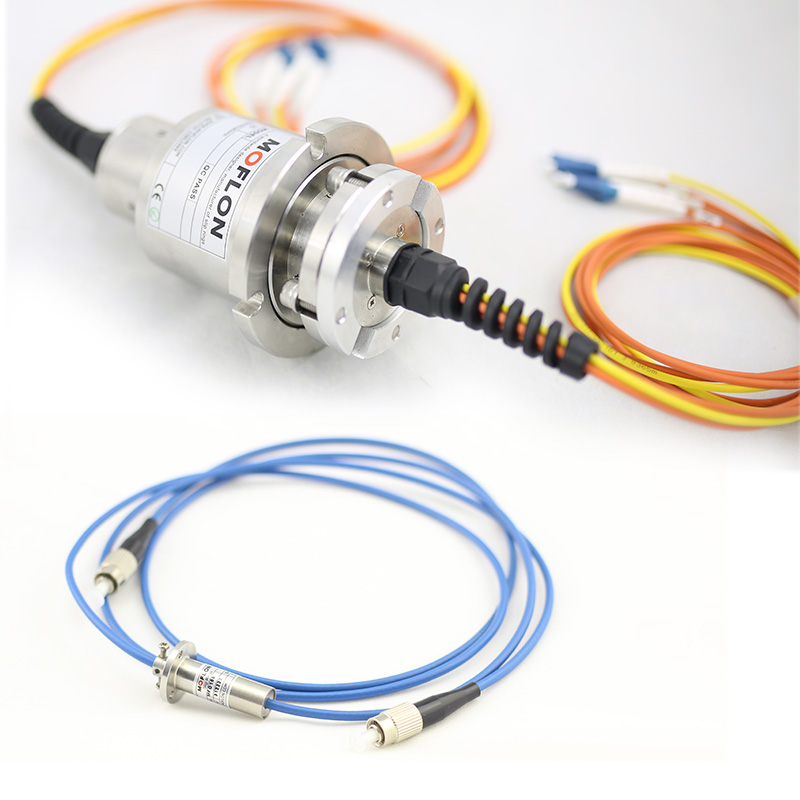
Picture a wind turbine yawing into the breeze while beaming real-time blade sensor data to a control room miles away. Or a surgical robot spinning infinitely without tangling delicate fiber-optic cables. These scenes share an unassuming hero: the optical rotary joint, a device that transmits light across a rotating interface with almost magical seamlessness. Unlike their electrical cousins, they sidestep sparking, wear, and electromagnetic interference, making them ideal for environments where silence and precision aren’t just luxuries—they’re requirements.
What’s driving this subtle takeover isn’t a flashy breakthrough, but a quiet alignment of needs. Modern manufacturing leans heavily on vision systems and laser sensors that demand uninterrupted optical signals while parts spin at high speeds. Maritime communication buoys, tethered drones, and even theater lighting rigs are adopting these joints because they eliminate the maintenance headaches of slip rings while sustaining multi-gigabit data streams. It’s a classic case of a technology hiding in plain sight, gradually becoming indispensable as industries crave more data and less downtime.
The real surprise, though, is where they’re turning up next. Researchers are embedding them into undersea observatories to keep fiber lines twisting freely in deep currents. Architects are experimenting with kinetic building facades that channel daylight indoors through rotating prismatic elements. Each application shares a common thread: the need for motion without message loss. And as our world keeps spinning faster, these silent enablers will keep turning, unnoticed but utterly essential.
Leaving Copper Behind: The Real Reasons Engineers Are Switching
At a certain point, pushing more data through those twisted pairs becomes a fight against physics itself. Skin effect and dielectric losses ramp up sharply with frequency, turning what was once a clean signal into a fuzzy mess after just a few meters. Equalization and digital signal processing can only do so much before you're burning more power to condition the signal than to actually transmit it. That's the wall a lot of design teams hit—no incremental tweak can stretch copper beyond its fundamental limits.
Another quiet motivator is the sheer physical bulk. Routing dense bundles of shielded CatWhatever through conduits and cable trays isn't just an installation headache; the weight and bend radius constraints start dictating structural decisions. When you factor in grounding requirements and the potential for ground loops across different parts of a building, the bill of materials for a truly robust copper infrastructure becomes a list of compromises. Fiber sidesteps most of that, and it's immune to the electromagnetic noise that industrial environments or dense racks full of motors and inverters throw at you.
Of course, there's also the reality that the generation of engineers now leading projects grew up on Ethernet, but learned optics as a core part of their toolkit. They're not romantic about wire; they see a link budget and reach requirements. When a single-mode pair can cover distances that would make a copper link budget weep without needing repeaters, and the transceivers are no longer exotic enterprise expenses, the choice becomes almost automatic. It's less about abandoning copper and more about gravitating toward what gets the job done without a long list of caveats.
Precision Without the Hype: How Manufacture Shapes Performance
Precision in manufacturing often gets buried under flashy marketing claims, but the real story is quieter and more concrete. It’s about tolerances measured in microns, not adjectives. When a component is machined to exacting standards, performance stops being a gamble and becomes a guarantee. This isn’t about adding expensive bells and whistles—it’s the unglamorous grind of aligning tools, processes, and materials so that every piece leaves the line delivering the exact same outcome. That repeatability is what separates a product that occasionally shines from one that consistently works.
The materials themselves are only half the equation; how they’re shaped dictates their final character. A perfectly controlled forging process can align grain structures in metal to endure stress that an identical-looking cast part would crumble under. Similarly, the way composites are laid up, or the sequence in which heat treatments are applied, can nudge a material’s properties in subtle but critical directions. No amount of post-production inspection can fully compensate for shortcuts taken during manufacturing. The performance edge comes from knowing exactly how each step—molding, cutting, tempering—affects the whole, then refusing to deviate.
The irony is that the most impressive feats of precision are invisible to the naked eye. A bearing that spins without vibration, a seal that holds pressure for a decade, a surface smooth enough to glide rather than grind—these are the quiet triumphs of manufacturing discipline. They don’t shout for attention, but they define whether a machine hums or whines over time. In an age where marketing loves to inflate the ordinary, genuine precision earns its trust the hard way: through relentless process control that leaves nothing to chance.
Signal Purity on a Rotating Stage: Bandwidth and Beyond
When a signal source is mounted on a rotating stage, maintaining spectral cleanliness becomes a surprisingly intricate challenge. The physical motion introduces periodic modulations that can bleed into the carrier and its harmonics, creating sidebands that degrade phase noise performance. Traditional filtering often falls short because the interference is not stationary; it shifts with speed, acceleration, and even the mechanical resonances of the stage itself. To truly tame these artifacts, one must look beyond conventional band-limiting and consider the entire chain—from motor drive electronics to the contact dynamics in slip rings.
Bandwidth is usually the first knob engineers reach for, but it is only part of the story. Narrowing the loop bandwidth of a rotary joint or applying aggressive low-pass filtering can suppress high-frequency noise, yet low-rate mechanical wobble and bearing chatter creep in below the cutoff. These low-frequency perturbations are especially insidious because they can masquerade as close-in phase noise, fooling measurement systems. A more effective approach treats the rotating interface as a dynamic system, actively compensating for periodic errors through feed-forward techniques or adaptive cancellation that responds to the instantaneous angular velocity.
Beyond bandwidth, real signal purity hinges on minuscule details: the choice of dielectric materials in rotating couplers, the symmetry of the transmission path, and even thermal gradients across the joint. Any asymmetry in the rotating RF path can cause amplitude and phase ripple that varies with angle, effectively imprinting a “signature” on the signal. Mitigating these effects requires precision machining, careful material matching, and sometimes an in-situ calibration routine that maps the perturbations and applies correction factors. The goal is not merely to pass a signal through a rotating joint, but to do so without leaving any trace of the motion on the spectral output.
Built to Last: Why These Slip Rings Outlive the Systems They Serve
Long after the motors have been swapped out and the control boards upgraded, the slip rings at the heart of these rotating systems keep spinning. Their secret isn't just one big breakthrough—it's a series of stubborn, small choices. The contacts are forged from a proprietary gold alloy so dense it shrugs off pitting, while the brush assemblies float on precision micro-bearings that adjust to wear instead of fighting it. Even the dielectric housing was formulated after years of thermal cycling tests, expanding and contracting at the same rate as the internal ring stack to keep moisture and dust locked out without cracking a seal.
Most manufacturers spec their rings for a fixed number of rotations. Ours were designed around a different metric: boredom. The goal was to make a component so uneventful that field technicians eventually forget it's there. That meant running continuous 24/7 life tests in caustic mist chambers, deliberately starving bearings of lubrication, and reversing direction under load thousands of times—the kind of abuse that sends ordinary slip rings into spikey electrical noise and early failure. The resulting design barely flinches. We've pulled units from decommissioned wind turbines after 18 years of salt-spray exposure and measured contact resistance variation under 5 milliohms.
It also helps that these slip rings were never allowed to be the bottleneck. The internal wiring isn't just soldered; it's crimped, potted, and strain-relieved in three separate stages. The junction between stationary and rotating elements uses a labyrinth seal that has no wearing parts—just a series of grooves that trap contaminants through momentum and gravity. When the surrounding machinery finally reaches end-of-life, it's not unusual for customers to return the slip rings for inspection, only to have them cleaned, re-lubricated, and sent right back into a new build.
FAQ
An optical slip ring is a rotary joint that transmits optical signals between stationary and rotating parts. Unlike traditional slip rings that use physical metal brushes or contacts to transfer electrical power and signals, optical slip rings rely on fiber optics or free-space optics to send data via light. This eliminates mechanical wear and electrical noise, making them ideal for high-bandwidth, interference-free data transfer in rotating systems.
Modern systems increasingly demand high-speed data transfer and resistance to electromagnetic interference, which conventional copper-based slip rings struggle to provide. Optical slip rings offer virtually unlimited bandwidth, low latency, and immunity to EMI, making them critical for applications like high-definition video surveillance, radar systems, and medical imaging where signal integrity is paramount.
The primary advantages include: no electrical contact wear, leading to longer lifespan; immunity to electromagnetic interference, ensuring clean signal transmission; higher data rates, supporting multi-gigabit per second speeds; compact and lightweight design; and the ability to multiplex multiple optical channels over a single fiber, reducing complexity.
China-made optical slip rings are widely used in defense systems (such as radar and electro-optical targeting), wind turbines (for pitch control and data monitoring), medical equipment (CT and MRI scanners), robotics, and offshore/marine applications. Their growing reputation for reliability and cost-effectiveness has expanded their presence in these sectors globally.
Advanced designs incorporate precision alignment mechanisms and high-quality optical components to keep insertion loss minimal. They often use expanded beam optics or fiber collimators to maintain stable coupling despite rotation. Anti-reflective coatings and robust housings protect against dust and vibration, ensuring consistent performance even in harsh conditions.
Engineers should evaluate the required data rate, wavelength range, number of optical channels, environmental conditions (temperature, humidity, vibration), mechanical constraints (size, rotational speed), and integration with existing power or fluid slip rings. Long-term reliability, maintenance needs, and supplier support are also crucial for demanding applications.
Yes, hybrid slip rings combine optical channels for data with separate paths for electrical power or fluid. The optical section uses fiber or free-space transmission, while conductive rings or fluid rotary unions handle power and media. This allows a single unit to deliver high-speed data alongside power, simplifying system design.
Recent advances include smaller form factors with higher channel counts, integrated wavelength division multiplexing for denser data links, improved sealing for extreme environments, and lower cost through automated manufacturing. Chinese manufacturers have also focused on custom solutions for emerging fields like autonomous vehicles and smart manufacturing, boosting global competitiveness.
Conclusion
At the heart of China’s optical slip rings lies a non-contact architecture that replaces traditional metal brushes with precision-aligned fiber optics or free-space optics. This shift eliminates mechanical wear, enabling uninterrupted transmission of high-bandwidth signals through a rotating interface. Engineers leverage wavelength division multiplexing and collimating lenses to push data rates beyond 100 Gbps while maintaining phase stability—critical for CT scanners and radar pedestals. The technology’s core advantage is its immunity to electromagnetic interference, allowing pristine signal purity even in harsh industrial environments. By decoupling rotation from electrical contact, these joints deliver both longevity and a clean signal path that copper-based systems simply cannot match.
The silent takeover of optical rotary joints in wind turbines, robotic arms, and medical imaging reflects a deeper engineering rationale: freedom from maintenance and data bottlenecks. Unlike their copper forebears, optical slip rings need no regular cleaning or replacement, often outlasting the systems they serve. Their manufacturing process—centered on sub-micron alignment and hermetic sealing—determines real-world performance more than any spec sheet. Engineers are migrating en masse because they gain not just bandwidth, but a fundamentally more reliable rotary link that sidesteps crosstalk, grounding loops, and the slow degradation of contacts. In modern systems where uptime and signal integrity are paramount, China’s advanced optical rotary transmission has become the invisible backbone, turning silently while the machinery around it evolves.
Contact Us
Contact Person: Xiangpin Li
Email: [email protected]
Tel/WhatsApp: 86 186 1706 8578
Website: https://www.moflon.com