
China Glue Dispensing Machine: Key Features and Buying Considerations
2026-11-03
Sourcing a glue dispensing machine from China isn’t just about picking the lowest quote. The real decision hinges on features like valve type, repeatability, and after-sales support — details that often get buried in spec sheets. In this guide, we break down what actually matters when comparing models, from precision to scalability. Whether you’re upgrading a single line or planning high-volume production, understanding these buying considerations will save you costly mistakes. And if you’re looking for a manufacturer that prioritizes both performance and support, JATEN is worth a close look.
Dispensing Accuracy That Survives Real Production Runs
Most dispensing systems look precise in a lab demo, with clean nozzles and a single operator watching every drop. Put them on a busy line where vibration, dust, and material batch changes are constant, and the story shifts fast. The accuracy you actually get depends on how the system handles feedback from the real world, not just its stepper motor specs. That means monitoring pressure fluctuations at the valve, adjusting for viscosity drift as the shift wears on, and catching volume deviations before they become scrap.
One common failure is treating calibration as a morning-only ritual. On long runs, dispense tips clog slightly, seals warm up, and air bubbles sneak into the fluid path. A robust setup doesn't wait for an operator to notice a bad part. It continuously compares target weight or volume against real-time measurements from in-line scales or flow sensors, then nudges parameters automatically. If a nozzle starts to deviate beyond a tight tolerance, the system flags it for cleaning rather than silently producing hundreds of off-spec units.
The difference shows up in the reject bin at hour six. Systems that only hold accuracy for the first few cycles create hidden costs in rework, material waste, and customer complaints. Those built for production runs assume that conditions will degrade and design for that reality. That might mean using carbide needles that resist wear, temperature-compensated fluid reservoirs, or closed-loop controls that don't rely on a fixed pulse width. Real accuracy isn't a spec sheet number; it's what remains when nobody has time to babysit the machine.
Matching Valve and Nozzle to the Actual Adhesive
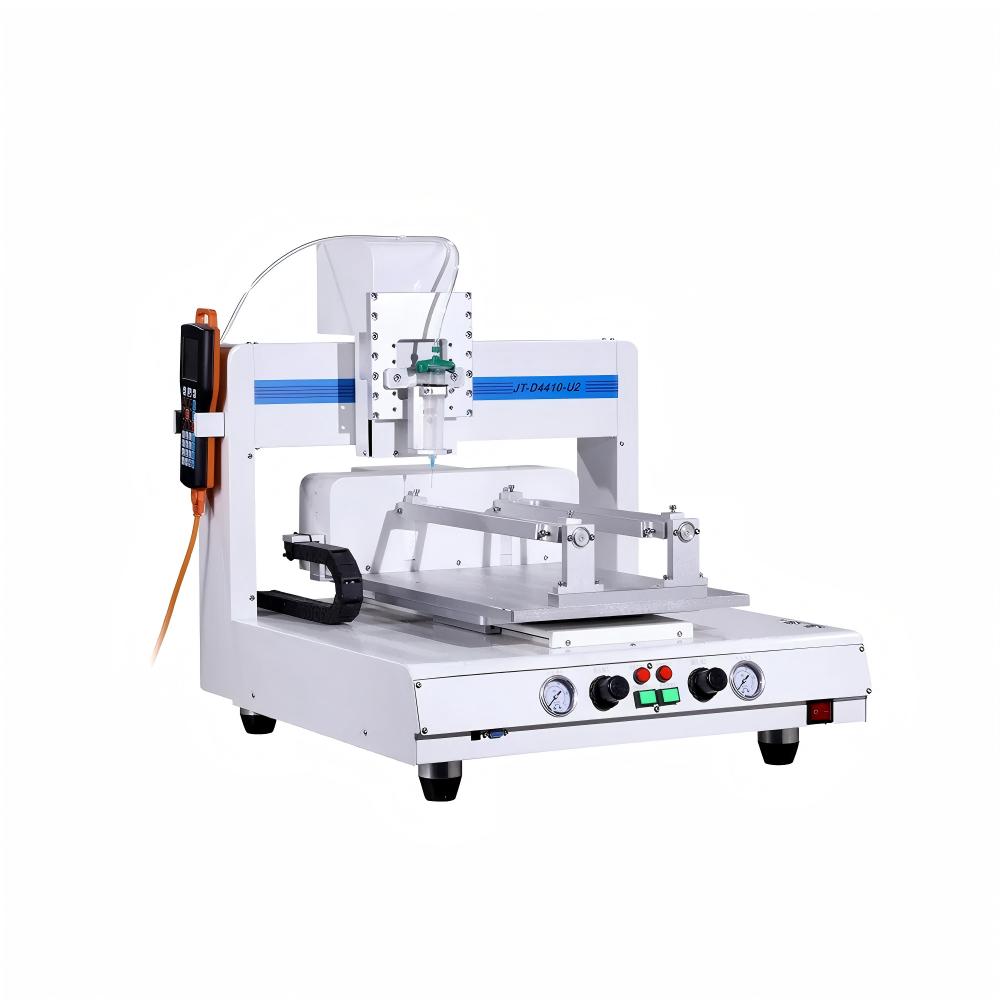
Choosing the right dispensing valve starts with the adhesive's viscosity and filler content. Thick pastes loaded with abrasives demand a valve with hardened seats and a wide-open flow path, while watery cyanoacrylates need precision needle valves to prevent drips between cycles. If the adhesive cures on contact with moisture, the valve seal and nozzle tip must stay fully enclosed when idle.
Nozzle selection follows the same thread: tapered stainless tips handle high-pressure bead paths, but a low-viscosity UV adhesive will wick and drool unless the orifice is sized for its surface tension. For two-part epoxies, the static mixer length has to match both the pot life and the required deposit shape—too short and the blend stays streaky; too long and the material starts gelling inside the mixer before it reaches the part.
Field tests usually save more time than datasheets alone. Run the actual adhesive through the candidate valve and nozzle at production speed, then check for stringing, clogging, or air entrapment after a short idle period. A combination that works perfectly with a 50,000 cP urethane can fall apart with a 3,000 cP acrylic because the shear thinning behavior changes the effective flow rate and backpressure.
Automation Features That Won't Complicate Your Line
Many automation upgrades sound great until you see the integration timeline. The features that actually keep a line simple are the ones that drop in without demanding a full retool. Think modular grippers, quick-change end effectors, and control interfaces that mirror the machines your operators already know.
Instead of adding another layer of programming complexity, these systems rely on preset routines and teach modes that take minutes to learn, not weeks. A good automation feature should reduce manual handling while letting your team stay in charge—no need to call in an integrator every time the product changes.
The real test is whether the line can run a new SKU the same afternoon the equipment is installed. If the automation requires rewiring, custom brackets, or specialized training, it's already complicating things. The best features are almost boring: they just work, quietly, and then get out of the way.
Material Compatibility Pitfalls You Can Sidestep
A classic trap is pairing stainless steel fasteners with aluminum panels in outdoor fixtures. The stainless looks indestructible, but in the presence of moisture it turns the aluminum into a sacrificial anode. Within months you'll find white, crusty corrosion around the holes, even though the bolts themselves remain pristine. A quick fix is to use nylon or coated washers, or switch to fasteners with a similar galvanic potential.
Elastomer incompatibility causes a surprising number of field failures. Take EPDM seals and synthetic greases—certain esters and petroleum-based lubricants will swell the rubber, reducing its durometer and eventually causing extrusion or leaks. It's not enough to glance at a generic rubber-vs-oil chart. Temperature and exposure time can push a marginal pairing into failure, so small-scale immersion testing under actual service conditions is worth the effort.
Plastic fittings have their own hidden pitfalls. A threaded PVC or polycarbonate component may crack weeks after assembly because the thread sealant contained a solvent that attacked the polymer. Even products labeled 'universal' can be aggressive on certain resins. Keeping a short list of sealants that have been proven on the specific plastic in use—and sticking to it—prevents callbacks that are hard to trace.
Maintenance and Spare Parts: The Hidden Cost Factor
The purchase price of a machine rarely tells you what it will actually cost to keep it running. In many plants, the real drain comes later, when a critical bearing fails, a proprietary sensor burns out, or a gearbox needs a rebuild that only one overseas supplier can handle. These expenses arrive in small increments but compound quickly, especially if the equipment was chosen without checking how easily its consumable parts can be sourced locally.
Spare parts inventory adds another layer of pressure. Holding too much stock locks up capital and creates obsolescence risk, while holding too little can turn a two-hour repair into a three-week shutdown. The sweet spot differs by industry; a food processor running 24/7 may justify keeping a spare motor on the shelf, but a workshop with intermittent use might be better off relying on a nearby distributor. Ignoring this balance often leads to rushed air freight charges and overtime labor that never appear in the original budget.
Calculating total cost of ownership forces you to look beyond the invoice. Include expected wear items, labor for routine servicing, and the lead time for non-standard parts. A slightly more expensive machine that uses common seals and standard belts can end up cheaper over five years than a bargain unit that requires custom-machined spares from a single source. Maintenance and spare parts are not an afterthought; they are the quiet recurring bill that determines whether an asset is truly economical.
What to Verify Before Committing to a Supplier
Ask for a recent client reference in your own industry, then call them. A supplier can send polished samples and still run a chaotic floor. You want to hear how they handled a delay, a quality slip, or a last-minute change. If the reference hesitates or only offers praise, treat that as a missing data point.
Check whether the ownership structure and production capacity are stable enough for your order size. A factory that normally handles 5,000 units a month will not suddenly manage 50,000 without subcontracting. Request a breakdown of raw material sources, lead times for each component, and their own incoming inspection records. Also verify that the compliance certificates they show are still valid for the specific product category you are buying, not just a similar one.
Place a small trial order before any large commitment, and watch how the supplier communicates when something goes off-script. Late replies, vague answers about packaging specs, or missing shipping documents on a 200-unit test run tell you more than any audit report. Keep the trial terms identical to your future orders so the behavior you observe is the behavior you will get.
FAQ
Focus on the dispensing valve type and controller resolution rather than just the machine frame. Look for a valve that can handle your adhesive's viscosity range—many suppliers offer needle, diaphragm, or jet valves. The controller should give you fine control over dispense time, pressure, and vacuum suckback. Also check whether the machine includes a teach pendant or software for programming dot, line, and arc patterns. A solid aluminum base and linear guide rails matter more than fancy touchscreens.
Ask the supplier for the maximum feed pressure the system can handle and the recommended valve type for thick pastes. High-viscosity materials usually need a positive displacement valve like an auger or piston valve rather than a simple time-pressure dispenser. Request a video of the machine dispensing a similar paste with a specified needle size, and ask about the minimum shot size and cycle rate at your target viscosity. If possible, send a sample of your adhesive for a free dispensing test before placing an order.
Common pain points include inconsistent shot volume due to low-quality pressure regulators, inaccurate positioning from loose linear guides, and poor after-sales support for software updates. To avoid these, request a detailed bill of materials—look for branded regulators like SMC or Festo, and stepper or servo motors from known manufacturers. Ask for a repeatability test report with actual dispensed weights. Also clarify warranty terms, spare parts availability, and whether remote technical support is included.
Pneumatic machines are cheaper and simpler, ideal for low-viscosity adhesives and moderate production speeds. Electric machines with servo-driven valves give you more precise shot control and higher repeatability for critical applications like medical device assembly. If your adhesive changes viscosity with temperature or you need to dispense very small dots, go electric. For general bonding or potting where tolerance is wider, a pneumatic setup with a good regulator can be enough.
Ask how they handle software updates and whether there is an English version of the interface. Confirm the lead time for replacement parts like needles, valves, and seals. Request the contact details of existing overseas customers for reference checks. Clarify the process for troubleshooting: do they offer video call support, and what is the typical response time? Also check if they provide a detailed user manual in English and whether installation can be done remotely.
Don't just look at the purchase price. Calculate the cost of spare parts like dispensing tips and valve seals over a year, expected downtime from clogging or calibration, and energy consumption. A machine with a cheaper upfront cost but higher maintenance needs can end up more expensive. Ask suppliers for the MTBF (mean time between failures) of the valve and controller. Also factor in training time for operators if the interface is less intuitive.
Yes, but you need to confirm the maximum dispense cycle rate and whether the controller supports external trigger signals from a PLC. Look for machines with an I/O port or communication protocol like Modbus. High-speed dispensing often requires a jet valve rather than a contact needle valve. Ask for a video showing the machine dispensing at your required dots per second and ask about the valve's response time. Also check if the machine can be mounted on a robotic arm or gantry.
Standard benchtop machines usually ship within 1-2 weeks after payment confirmation, while customized robotic systems can take 4-8 weeks. Most suppliers ship by air freight or express courier for smaller units, which takes 5-10 days. For larger machines, sea freight is more economical but takes 30-45 days. Make sure the supplier packs the machine with desiccant and anti-vibration foam, and confirm the Incoterms and customs documentation provided. Request a pre-shipment video of the machine running your sample adhesive.
Conclusion
When sourcing a glue dispensing machine from China, the first thing to test is whether its accuracy holds up after hours of continuous cycling, not just in a clean demo. A machine that drifts after a few hundred shots will quietly ruin assemblies. Matching the valve and nozzle to the actual adhesive matters more than the machine's top speed; a thick epoxy behaves nothing like a low-viscosity cyanoacrylate, and the wrong pairing leads to stringing, clogging, or inconsistent bead widths. Look for automation features that slot into your existing line without forcing a controls overhaul. A simple pneumatic interface or dry-contact start signal often beats a touchscreen packed with options nobody will use.
Material compatibility is where many buyers stumble. Wetted parts must withstand your solvent, filler, or abrasive compound, otherwise seals swell and metal erodes within weeks. Ask for a detailed list of compatible materials, not just a generic claim that it works with most adhesives. Maintenance costs can outweigh the initial price if spare parts are scarce or proprietary. Check whether needles, seals, and valve internals are standard sizes you can source locally. Finally, before committing to a supplier, request a trial with your actual adhesive and a real production part. A credible manufacturer will offer this without hesitation. Verify lead times for critical spares, response time for technical support, and whether the warranty covers wear items. These checks separate machines that merely dispense glue from those that keep your line running.
Contact Us
Contact Person: Volien
Email: [email protected]
Tel/WhatsApp: +86 18029161762
Website: https://www.jatentech.com/